> For the complete documentation index, see [llms.txt](https://help.iodd.kr/llms.txt). Markdown versions of documentation pages are available by appending `.md` to page URLs; this page is available as [Markdown](https://help.iodd.kr/bootable-virtual-drive/virtual-drive-vhd/convert-iso-file-to-uefi-bootable-drive.md).
# Convert ISO file to UEFI bootable Drive
Guide for converting an ISO file into a UEFI-bootable virtual drive.
{% hint style="info" %}
This process converts an ISO file into a bootable virtual drive, functioning similarly to a USB flash drive or a Windows-To-Go (WTG) drive.
{% endhint %}
### Prerequisites
* **ISO File**: The source OS installation image.
* **Mounted VHD (Empty)**: A VHD file created and mounted via IODD.
* Refer to: [Creating VHD Files](/bootable-virtual-drive/virtual-drive-vhd/create-vhd-file-with-vhd-tools.md)
* **Rufus Application**: Download from
***
### Step-by-Step Conversion
#### 1. Mount the VHD File
Mount the prepared empty VHD file on your IODD device. It will appear as a "Virtual Drive" on your PC.
#### 2. Configure Rufus
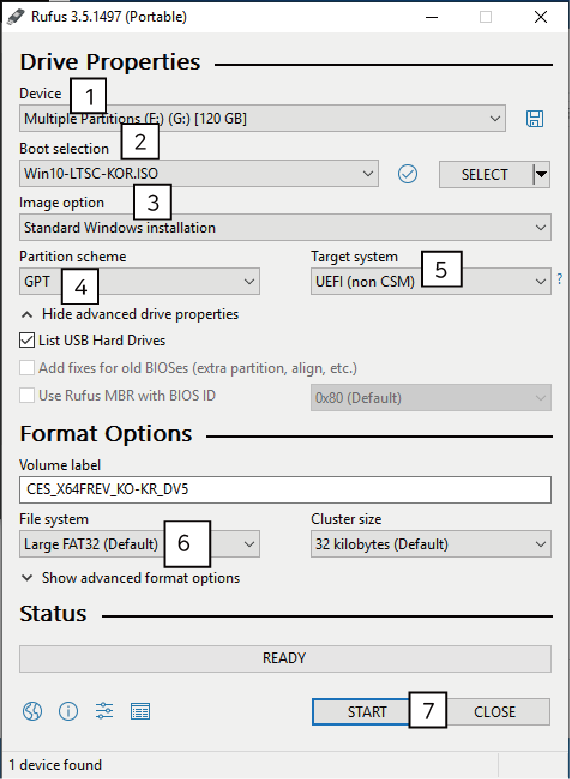
Run the **Rufus** application with **Administrator privileges**.
Configuring Rufus for VHD installation
1. **\[Device]**: Select the **mounted VHD drive** (Ensure it is the virtual drive, not a physical disk).
2. **\[Boot selection]**: Click **SELECT** and choose your original ISO file.
3. **\[Image Option]**: Select **Standard Windows installation** (or **Windows To Go** if you wish to run the OS directly from the drive).
4. **\[Partition scheme]**: Set to **GPT**.
5. **\[Target system]**: Set to **UEFI (non CSM)**.
{% hint style="info" %}
For better compatibility with certain **Win-To-Go** installations on older systems, using **MBR** / **BIOS (or UEFI-CSM)** may be required.
{% endhint %}
6. **\[File system]** & **\[Cluster size]**: It is highly recommended to use the **default values**.
7. Click the **\[START]** button to begin the bootable file creation.
{% hint style="danger" %}
**Verify Target Drive Selection** Always double-check that the target drive is the **VHD-mounted "Virtual Drive."** Never select the physical IODD drive itself, as this will lead to data loss. Enabling **Write-Protection** on the physical drive before starting is a recommended safety measure.
{% endhint %}
***
### 3. Booting from the Virtual Drive
Once the process in Rufus is complete, you must configure your PC to boot from this virtual drive.
1. Save the current state of the IODD by pressing the **\[9]** key.
2. Follow the instructions in the **CMOS/BIOS Boot Order Setting** section:
* [Go to BIOS Setup Guide](/bootable-virtual-drive/virtual-odd-iso.md#cmos-bios-boot-order-setting)
{% hint style="warning" %}
To ensure the virtual drive is recognized during the boot sequence, some motherboards may require the IODD to be set to **VHD-only mode** or have the specific VHD file pre-selected and saved as the primary boot state.
{% endhint %}