> For the complete documentation index, see [llms.txt](https://help.iodd.kr/llms.txt). Markdown versions of documentation pages are available by appending `.md` to page URLs; this page is available as [Markdown](https://help.iodd.kr/bootable-virtual-drive/virtual-drive-vhd/wtg-boot-camp-mac-osx.md).
# WTG/Boot Camp (Mac OSX)
Guide for setting up Windows To Go (WTG) and Boot Camp for Intel/AMD PCs and Intel-based Macs.
{% hint style="danger" %}
**Compatibility Warning** Boot Camp installation via this method is **not supported on Apple Silicon Macs** (M1, M2, M3, etc.). This guide applies only to Intel-based Mac models.
{% endhint %}
Portable Windows environment for PC and Mac
The combination of IODD's WTG (Windows To Go) capability and encryption features allows for a secure, portable booting solution on both standard PCs and Intel-based Macs. For the full setup process, please also refer to the UEFI Booting guide.
{% hint style="info" %}
**Prerequisites** Since the VHD Tool and Rufus are **Windows-only applications**, you must have access to a Windows environment for the initial setup.
* **VHD Tool**: [Download and Guide](/bootable-virtual-drive/virtual-drive-vhd/create-vhd-file-with-vhd-tools.md)
* **Rufus**: [Download](https://rufus.ie/)
* **Windows ISO**: Windows 8.1, 10, or 11 (Professional / Enterprise recommended)
{% endhint %}
***
### Preparations
1. **Boot Camp Support Software (Drivers)**:
* Download the necessary drivers via the **Boot Camp Assistant** (Control Panel) on your Mac.
* Store these drivers on an external USB drive or a separate VHD file.
2. **VHD File for Installation**:
* A **Fixed-size VHD** is highly recommended for optimal performance.
* Refer to: [Creating VHD Files](/bootable-virtual-drive/virtual-drive-vhd/create-vhd-file-with-vhd-tools.md)
***
### Rufus Configuration
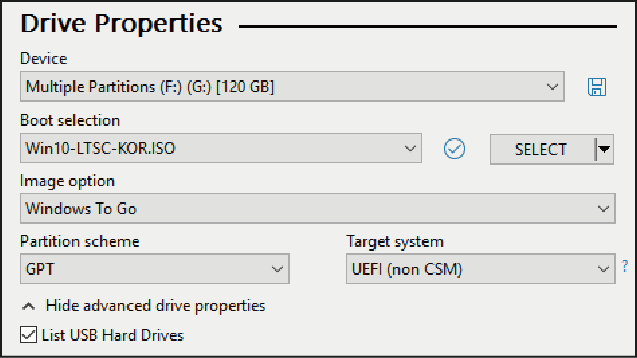
The basic configuration follows the standard UEFI boot settings. Refer to the [ISO to UEFI Conversion Guide](/bootable-virtual-drive/virtual-drive-vhd/convert-iso-file-to-uefi-bootable-drive.md) for details.
Configuring Rufus for VHD-based WTG installation
1. **Enable Advanced Options**: In Rufus, navigate to **\[Advanced Drive Properties]** and check **\[List USB Hard Drives]**.
2. **Select Target**: Choose the **mounted VHD drive** (the fixed-size virtual disk) as the target device.
3. **Partition & System**: Set the partition scheme to **GPT** and the target system to **UEFI (non CSM)**.
{% hint style="danger" %}
**Critical Selection Check** Ensure the target drive is the **VHD-mounted "Virtual Drive."** Never attempt installation directly onto the physical IODD disk, as this will result in total data loss. It is strongly recommended to enable **Write-Protection** on the physical IODD device as a safeguard.
{% endhint %}
***
### Booting into Boot Camp
1. Ensure your Mac is completely turned off.
2. Connect the IODD to the Mac.
3. Press the **Power button** while holding down the **\[Option] (Alt)** key.
4. When the boot manager appears, select the **Yellow EFI Boot icon**.
{% hint style="info" %}
During the first-time installation, hold the **\[Control]** key while selecting the disk to set it as the default boot device.
{% endhint %}
5\. After the Windows setup completes, install the \*\*Boot Camp Support Software (drivers)\*\* prepared earlier.
***
### Additional Resources
For official information regarding Apple Boot Camp, please visit: [Apple Support: Install Windows on your Mac with Boot Camp](https://support.apple.com/en-us/HT201468)